2026
The Risks of Imperfect Knowledge: Reliability Trade-Offs in Physics-Aware Neural Networks for Climate Projections
Mengxue Zhang, Kai-Hendrik Cohrs, Miguel-Ángel Fernández-Torres, Esther Rodrigo-Bonet, Gustau Camps-Valls
International Conference on Artificial Neural Networks (ICANN) 2026
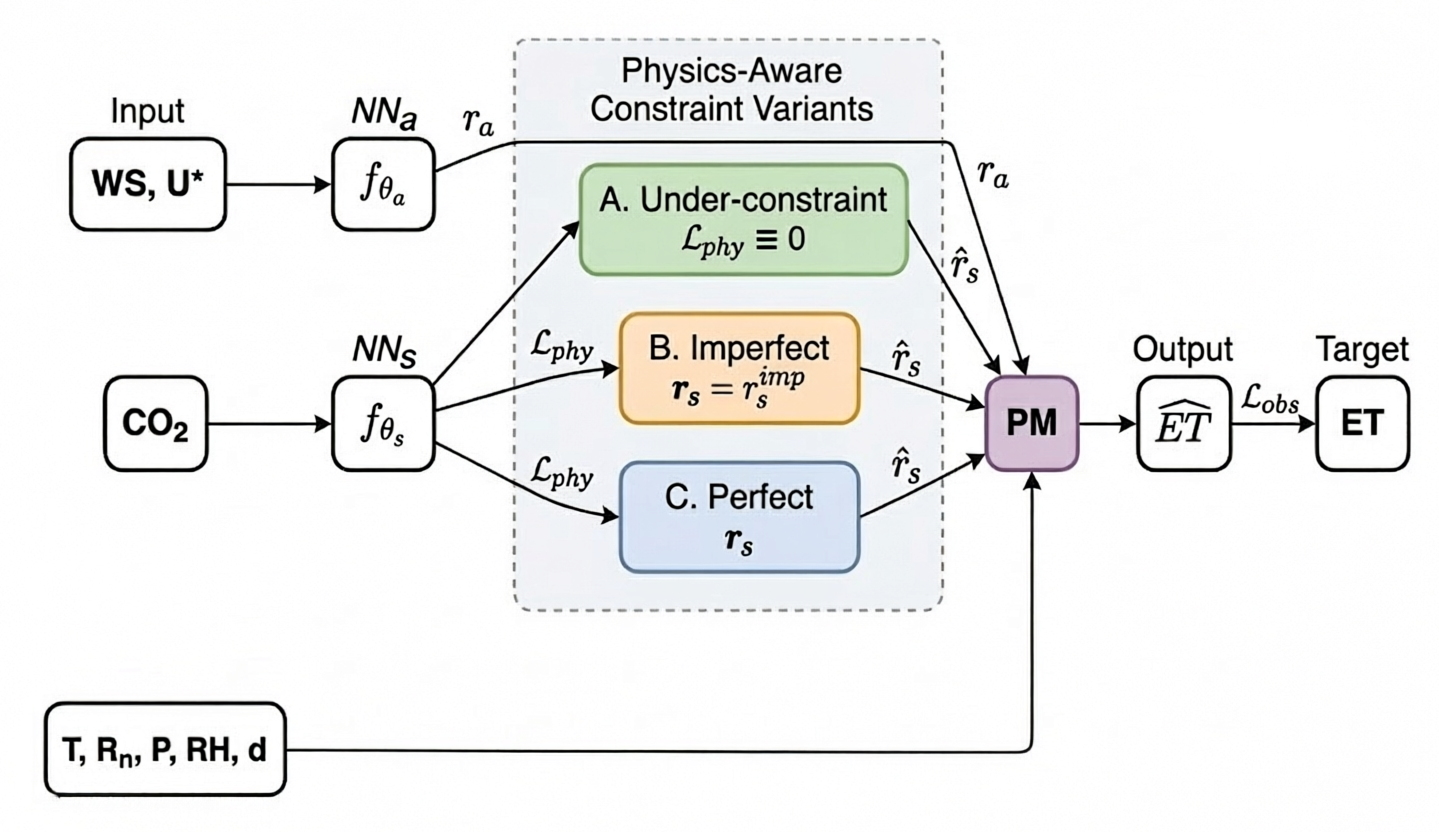
Hybrid models combining physical knowledge with machine learning in Earth system science face two fundamental challenges: equifinality, where distinct parameterizations yield equivalent training performance, and uncertainty arising from internal climate and scenario variability. To investigate the relationship between these challenges, this study evaluates how physical correctness affects predictive stability by categorizing physics-aware neural networks for evapotranspiration estimation into under-constrained, imperfect, and perfect knowledge subtypes. These models are tested using IPSL-CM5A-LR climate data across multiple realizations under historical and RCP scenarios (2.6, 4.5, and 8.5). Results show that while physical constraints mitigate equifinality via model regularization, their effectiveness depends strictly on the accuracy of the embedded knowledge. Imperfect constraints degrade performance, particularly under high-emission scenarios, whereas low-forcing regimes amplify model sensitivity to internal variability. Consequently, physical constraints alone do not guarantee reliability in climate projections; robust uncertainty quantification and regularization regarding climate change remain essential for developing trustworthy neural Earth system models.
The Risks of Imperfect Knowledge: Reliability Trade-Offs in Physics-Aware Neural Networks for Climate Projections
Mengxue Zhang, Kai-Hendrik Cohrs, Miguel-Ángel Fernández-Torres, Esther Rodrigo-Bonet, Gustau Camps-Valls
International Conference on Artificial Neural Networks (ICANN) 2026
Hybrid models combining physical knowledge with machine learning in Earth system science face two fundamental challenges: equifinality, where distinct parameterizations yield equivalent training performance, and uncertainty arising from internal climate and scenario variability. To investigate the relationship between these challenges, this study evaluates how physical correctness affects predictive stability by categorizing physics-aware neural networks for evapotranspiration estimation into under-constrained, imperfect, and perfect knowledge subtypes. These models are tested using IPSL-CM5A-LR climate data across multiple realizations under historical and RCP scenarios (2.6, 4.5, and 8.5). Results show that while physical constraints mitigate equifinality via model regularization, their effectiveness depends strictly on the accuracy of the embedded knowledge. Imperfect constraints degrade performance, particularly under high-emission scenarios, whereas low-forcing regimes amplify model sensitivity to internal variability. Consequently, physical constraints alone do not guarantee reliability in climate projections; robust uncertainty quantification and regularization regarding climate change remain essential for developing trustworthy neural Earth system models.
2025

Calibration and uncertainty quantification for deep learning-based drought detection
Mengxue Zhang, Miguel-Ángel Fernández-Torres, Kai-Hendrik Cohrs, Gustau Camps-Valls
International Journal of Applied Earth Observation and Geoinformation 2025
miscalibration and inherent uncertainty. However, they remain rarely explored because deep learning models are overparameterized and seldom tractable. To address this shortcoming, we introduce methodologies for model calibration and entropy-based uncertainty quantification for deep learning-based drought detection. The calibration algorithm can deal with calibration errors by reducing distributional shifts and alleviating overconfident predictions. The uncertainty framework, in turn, decomposes and quantifies the total uncertainty according to several components: data uncertainty, procedural variability, parametric variability, and latent variability. Thus, our method identifies uncertain predictions and supports robust evaluations, benefiting the credibility of the decision-making process. Empirical evidence of performance in a wide range of European drought events is given, justifying the effectiveness of our approach. The calibration methodology yields the lowest expected calibration error (0.31%) and the precision of the uncertainty-based decision-making is improved from 72.27% to 74.06% and 76.59%, based on ensemble predictions and rejecting the predictions for the top 20% uncertain negative samples, respectively. In summary, our approach significantly enhances drought detection’s reliability and classification accuracy, constituting a key step toward more trustworthy and actionable climate decision-making.
Calibration and uncertainty quantification for deep learning-based drought detection
Mengxue Zhang, Miguel-Ángel Fernández-Torres, Kai-Hendrik Cohrs, Gustau Camps-Valls
International Journal of Applied Earth Observation and Geoinformation 2025
miscalibration and inherent uncertainty. However, they remain rarely explored because deep learning models are overparameterized and seldom tractable. To address this shortcoming, we introduce methodologies for model calibration and entropy-based uncertainty quantification for deep learning-based drought detection. The calibration algorithm can deal with calibration errors by reducing distributional shifts and alleviating overconfident predictions. The uncertainty framework, in turn, decomposes and quantifies the total uncertainty according to several components: data uncertainty, procedural variability, parametric variability, and latent variability. Thus, our method identifies uncertain predictions and supports robust evaluations, benefiting the credibility of the decision-making process. Empirical evidence of performance in a wide range of European drought events is given, justifying the effectiveness of our approach. The calibration methodology yields the lowest expected calibration error (0.31%) and the precision of the uncertainty-based decision-making is improved from 72.27% to 74.06% and 76.59%, based on ensemble predictions and rejecting the predictions for the top 20% uncertain negative samples, respectively. In summary, our approach significantly enhances drought detection’s reliability and classification accuracy, constituting a key step toward more trustworthy and actionable climate decision-making.
2024

Domain knowledge-driven variational recurrent networks for drought monitoring
Mengxue Zhang, Miguel-Ángel Fernández-Torres, Gustau Camps-Valls
Remote Sensing of Environment 2024
In the context of climate change, droughts, increasingly frequent and severe, necessitate effective monitoring. Existing methods, such as drought indices and data-driven models, face important limitations. Drought indices are built on prior expert knowledge but lack calibration based on actual drought events, while data-driven models prioritize goodness of fit over real event identification, undermining their credibility and generalization, and also struggling to generalize from regional to large-scale contexts. To address these challenges, here we introduce a hybrid machine learning framework for time series that combines domain knowledge and observational data in a variational recurrent neural network. The network models the joint distribution of total precipitation, air temperature, and real drought events, providing accurate predictions and uncertainty estimates. Extensive experiments focusing on a wide range of European drought events from 2011 to 2018 consistently show that our hybrid model surpasses both drought indices and data-driven models in terms of accuracy in drought detection, underlining its effectiveness, robustness, and stability. Our model achieves the best ROC-AUC (%) results in Afghanistan (79.7 ± 0.5), Italy (84.3 ± 0.6), Russia (89.4 ± 0.2), Europe-0 (84.3 ± 0.1), and Europe-1 (82.8 ± 0.4), effectively capturing the starting and ending times of drought events with lower uncertainty, and also generalizing better for unseen locations.
Domain knowledge-driven variational recurrent networks for drought monitoring
Mengxue Zhang, Miguel-Ángel Fernández-Torres, Gustau Camps-Valls
Remote Sensing of Environment 2024
In the context of climate change, droughts, increasingly frequent and severe, necessitate effective monitoring. Existing methods, such as drought indices and data-driven models, face important limitations. Drought indices are built on prior expert knowledge but lack calibration based on actual drought events, while data-driven models prioritize goodness of fit over real event identification, undermining their credibility and generalization, and also struggling to generalize from regional to large-scale contexts. To address these challenges, here we introduce a hybrid machine learning framework for time series that combines domain knowledge and observational data in a variational recurrent neural network. The network models the joint distribution of total precipitation, air temperature, and real drought events, providing accurate predictions and uncertainty estimates. Extensive experiments focusing on a wide range of European drought events from 2011 to 2018 consistently show that our hybrid model surpasses both drought indices and data-driven models in terms of accuracy in drought detection, underlining its effectiveness, robustness, and stability. Our model achieves the best ROC-AUC (%) results in Afghanistan (79.7 ± 0.5), Italy (84.3 ± 0.6), Russia (89.4 ± 0.2), Europe-0 (84.3 ± 0.1), and Europe-1 (82.8 ± 0.4), effectively capturing the starting and ending times of drought events with lower uncertainty, and also generalizing better for unseen locations.
2022
Hybrid recurrent neural network for drought monitoring
Mengxue Zhang, Miguel-Ángel Fernández-Torres, Gustau Camps-Valls
NeurIPS 2022 Workshop on Tackling Climate Change with Machine Learning 2022
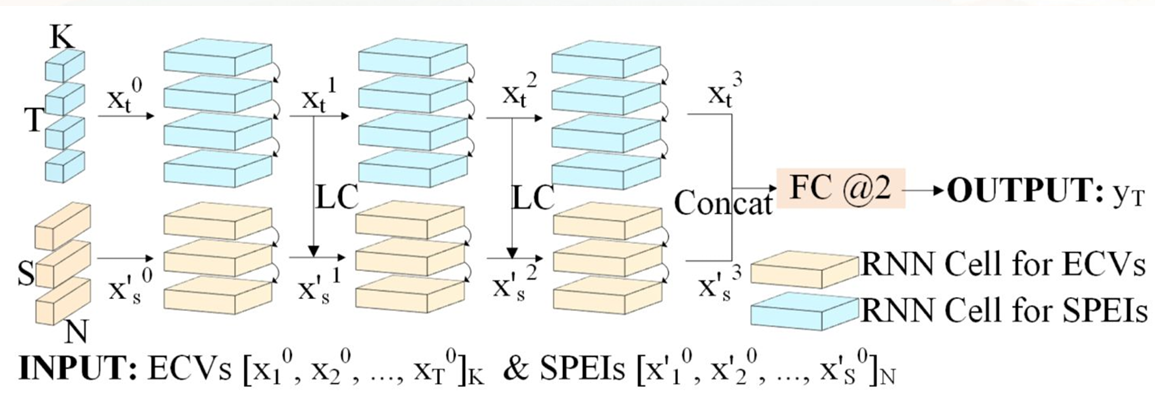
Droughts are pervasive hydrometeorological phenomena and global hazards, whose frequency and intensity are expected to increase in the context of climate change. Drought monitoring is of paramount relevance. Here we propose a hybrid model for drought detection that integrates both climatic indices and data-driven models in a hybrid deep learning approach. We exploit time-series of multi-scale Standardized Precipitation Evapotranspiration Index together with precipitation and temperature as inputs. We introduce a dual-branch recurrent neural network with convolutional lateral connections for blending the data. Experimental and ablative results show that the proposed system outperforms both the considered drought index and purely data-driven deep learning models. Our results suggest the potential of hybrid models for drought monitoring and open the door to synergistic systems that learn from data and domain knowledge altogether.
Hybrid recurrent neural network for drought monitoring
Mengxue Zhang, Miguel-Ángel Fernández-Torres, Gustau Camps-Valls
NeurIPS 2022 Workshop on Tackling Climate Change with Machine Learning 2022
Droughts are pervasive hydrometeorological phenomena and global hazards, whose frequency and intensity are expected to increase in the context of climate change. Drought monitoring is of paramount relevance. Here we propose a hybrid model for drought detection that integrates both climatic indices and data-driven models in a hybrid deep learning approach. We exploit time-series of multi-scale Standardized Precipitation Evapotranspiration Index together with precipitation and temperature as inputs. We introduce a dual-branch recurrent neural network with convolutional lateral connections for blending the data. Experimental and ablative results show that the proposed system outperforms both the considered drought index and purely data-driven deep learning models. Our results suggest the potential of hybrid models for drought monitoring and open the door to synergistic systems that learn from data and domain knowledge altogether.